




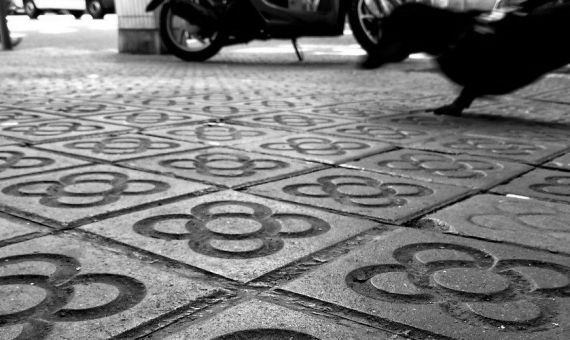
The Barcelona Flower slab is not a paver.

- its total length divided by its thickness is less than or equal to four.
If we divide its length (20 cm) by its thickness (4 cm), we obtain 5 cm, which is greater than 4. Conclusion: the 20x20x4 cm pavement is not a paver, it is a slab. 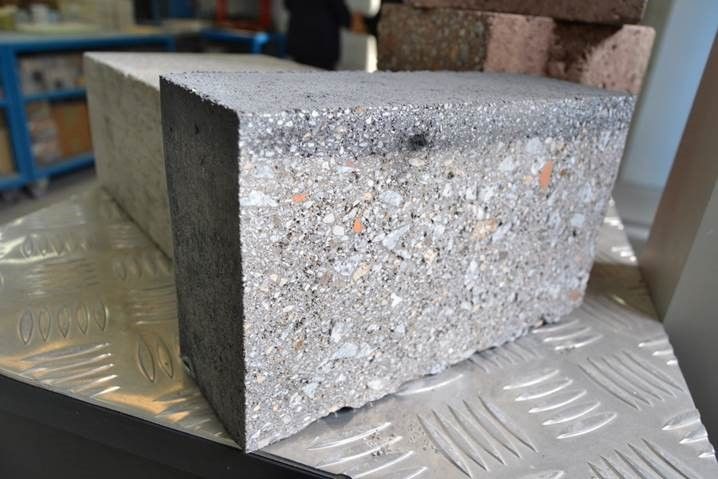
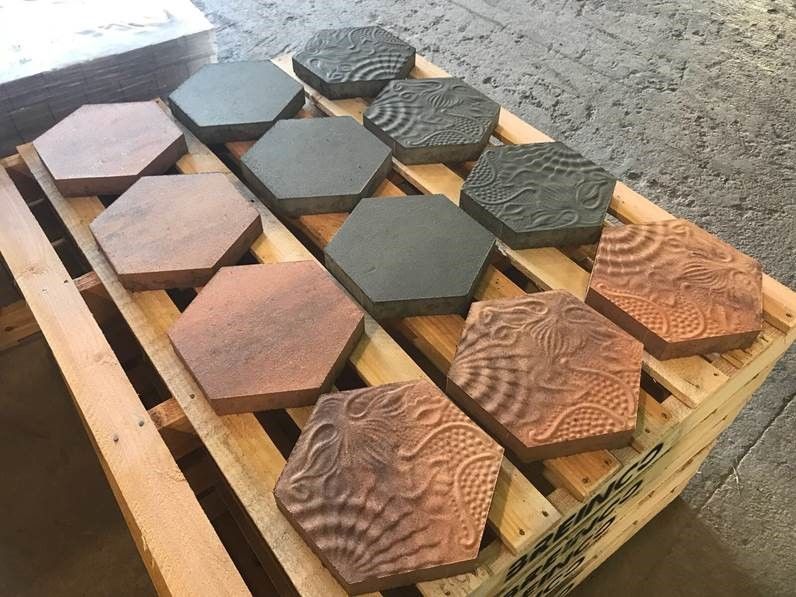
History of the Barcelona Flower slab
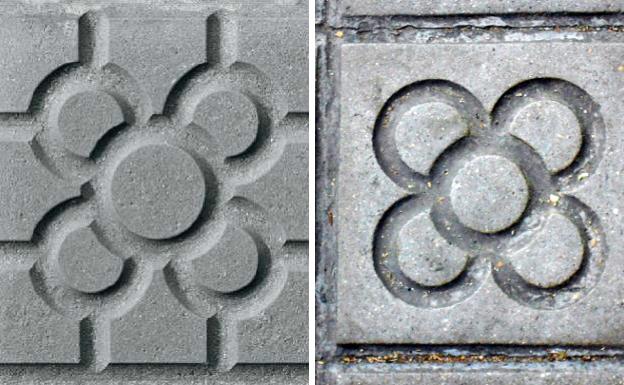
The Barcelona flower, also known as the Barcelona rose or Barcelona *panot*, is a 20×20 cm concrete piece made of cement, sand, and water that features a four-petal flower. The authorship of the design is attributed to the architect Josep Puig i Cadafalch, and its most relevant characteristics are its durability and easy maintenance. At the **beginning of the 20th century**, the city began to have significant mud problems on its streets. The chaotic situation in the Eixample district and the growth of Barcelona only made it worse. Before the appearance of the Flower slab, residents paved the two and a half meters in front of their houses with materials provided by the city council. To find a solution to the problem, various ideas were considered, and finally, five **slab models with negative relief** were established in 1906 to help solve the issue thanks to their textured design: a skull, a concentric circle, four tablets, four tablets with four circles, and the flower *panot*. Currently, some of these models are no longer manufactured due to low demand, and the “flower *panot*” has become the most widely used, making it the most symbolic. 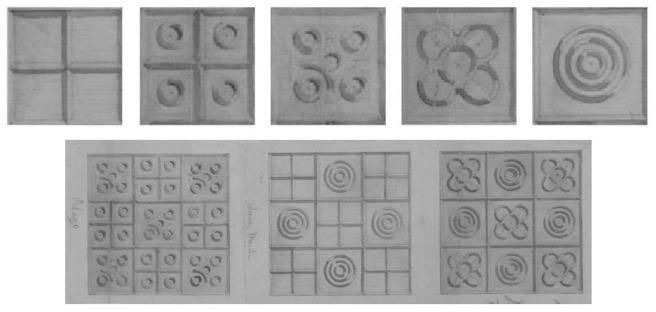
References
https://ca.wikipedia.org/wiki/Flor_de_Barcelona https://www.lavanguardia.com/local/barcelona/20180212/44628283022/historia-panot-barcelona-flor-calcada-portuguesa.html https://www.laramblabarcelona.com/panot-de-barcelona/
